

Have We Reached Peak Pop-Up?
Brooks Headley, Nancy Silverton, and more chefs who host other chefs weigh in.

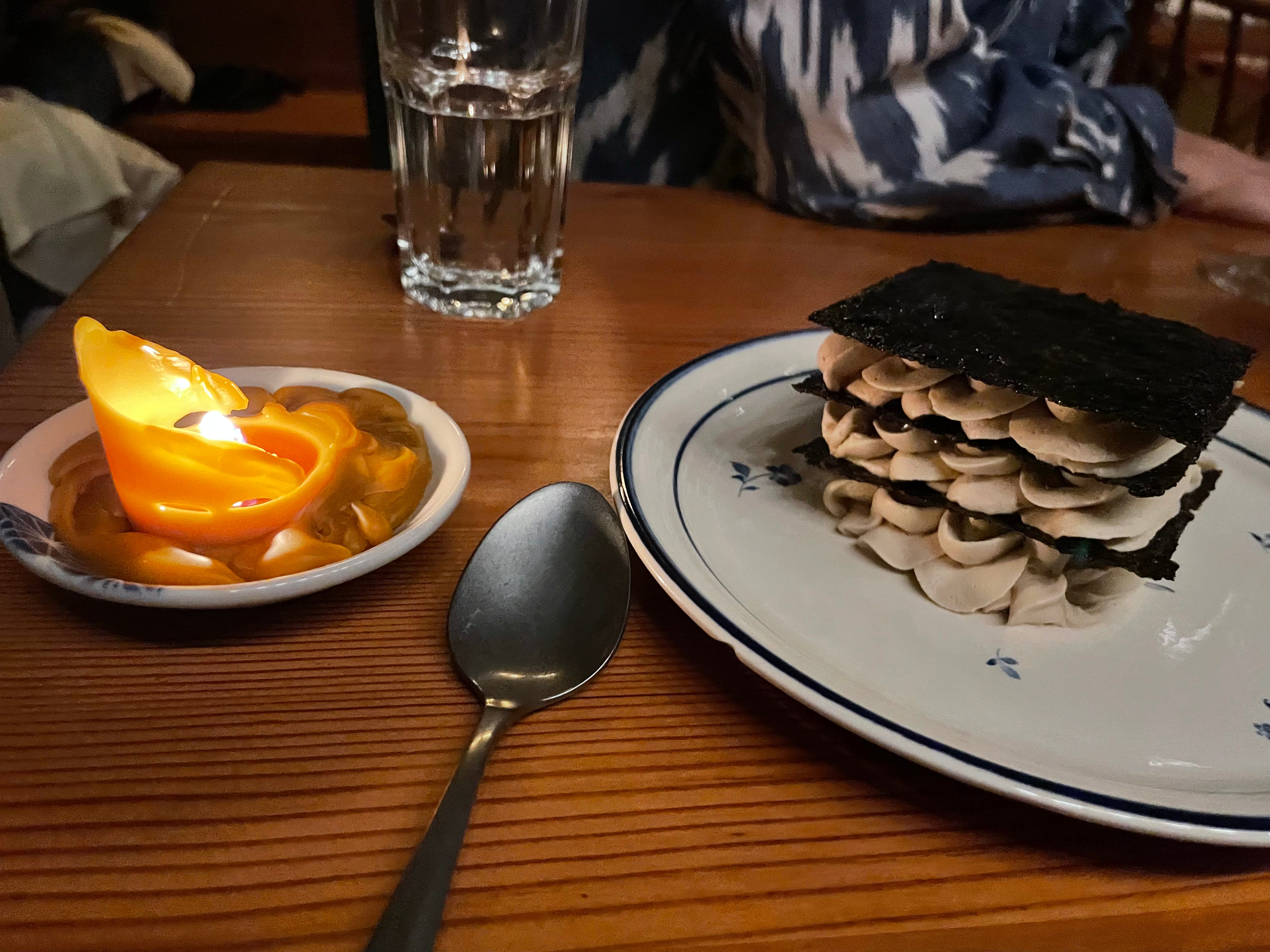
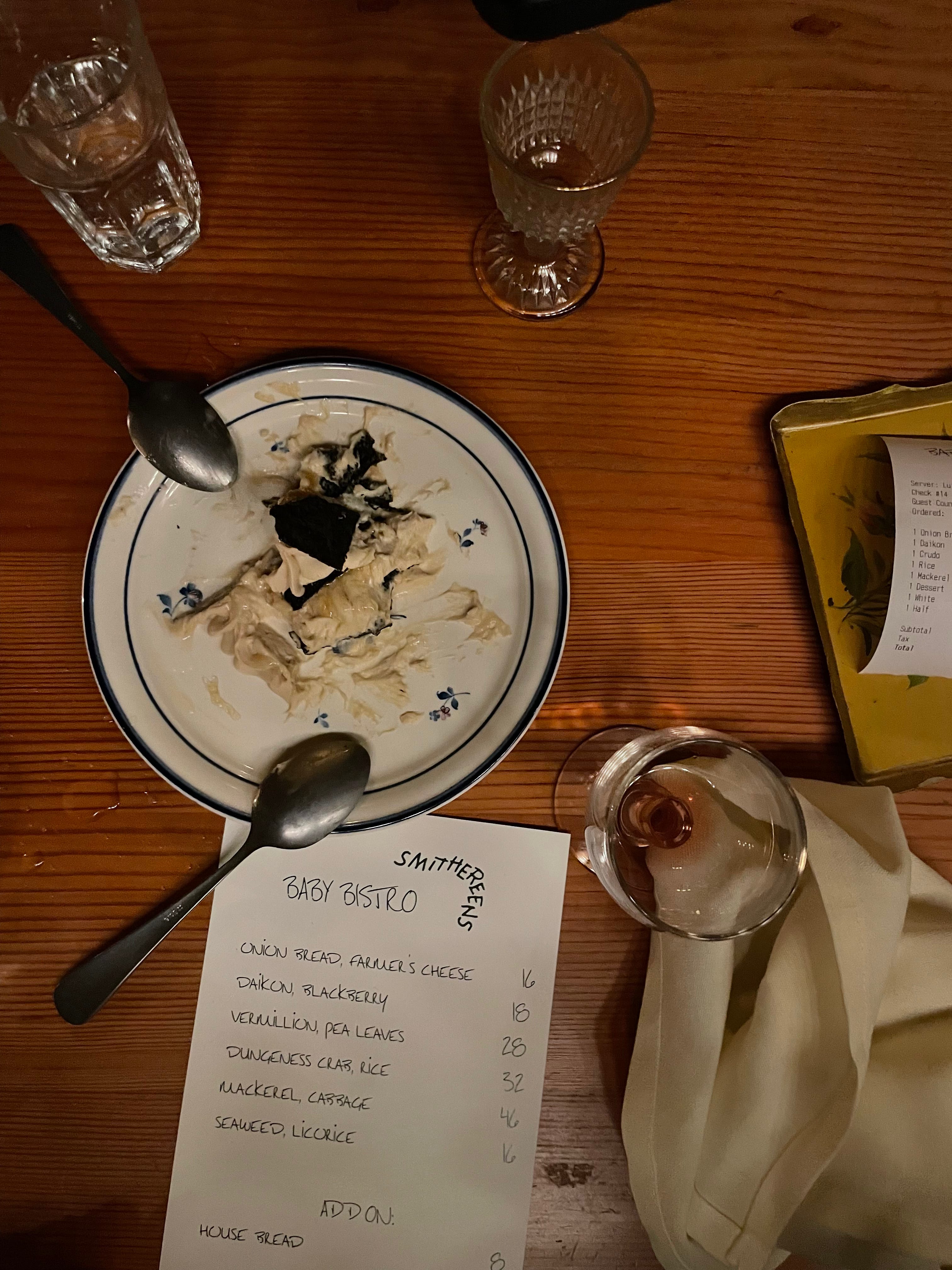
A few months ago, in a beautifully restored Victorian bungalow surrounded by banana trees, I cracked into the top layer of an elaborate nori-licorice mille-feuille. I was dining at Baby Bistro, but the dish was a signature dessert at Smithereens, a self-described “small, weirdo” seafood restaurant in New York’s East Village. Smithereens chef-owner Nick Tamburo was in L.A. for a few days, and had reached out to his old friend, Miles Thompson, to see if he wanted to cook together for a night.
Guest chef series, pop-ups, takeovers, collabs—call them what you will, but they’re absolutely everywhere right now. I can’t open my inbox or Instagram without being bombarded with flyers for restaurants hosting other restaurants, always for a limited time only. Bell’s Los Alamos welcomes Henrietta Red from Nashville! London’s Rochelle Canteen takes over Sailor in Brooklyn! SingleThread x Kato x Harbor House: one night only! The pop-ups keep popping up, coast to coast, with pairings that can feel either intuitive or random, or anywhere in between.
Sometimes I’m tempted, often I am not. As a diner, I can appreciate the chance to try a visiting chef’s food, especially if they’re someone I either know and love from elsewhere, or have admired from afar. But I’ve also been burned by chaotic services, disjointed menus, and overwhelming crowds at poorly planned collabs. If dining out is like live theater, pop-ups are the improv of the genre—exciting when executed well; deeply cringe-inducing when not.
Although pop-ups have existed in various forms for at least the past decade (i.e. cookbook tours, guest chef residencies, bars partnering with chefs), Covid was the undeniable turning point in pop-up history. With restaurants shuttered, out-of-work chefs got creative, cooking in unexpected places and advertising via social media.
The current moment—of restaurant-on-restaurant pop-up saturation—is a relatively recent phenomenon. Is it an outgrowth of the pandemic-era spirit of collaboration, or a shrewd marketing opportunity in an increasingly crowded restaurant (and food media) landscape? A bit of both, I’d posit, along with the simple truth that chefs like hanging out with other chefs, and this is a formal route to doing so that also enables them to drum up a little attention along the way. The fact that reservation platforms, credit card companies, and deep-pocketed brands are now competing to subsidize these events? Icing on the cake.
If dining out is like live theater, pop-ups are the improv of the genre—exciting when executed well; deeply cringe-inducing when not.
Still, I have questions: How do these events come together? Who’s organizing them (Chef-owners? Publicists? Brands with $$$?), and how do they ensure things run smoothly for all parties? Even with corporate sponsorship, is anyone making money off this equation? And, more existentially: Why do chefs continue perpetuating pop-ups, and have we reached the point of no return?
I, as merely one part of the equation (the occasional guest), don’t have all the answers. So I assembled a panel of experts—chefs and restaurateurs in Los Angeles and New York who have been on all sides of the setup, to unpack why we’re living in this moment of peak pop-up, and where we go from here.
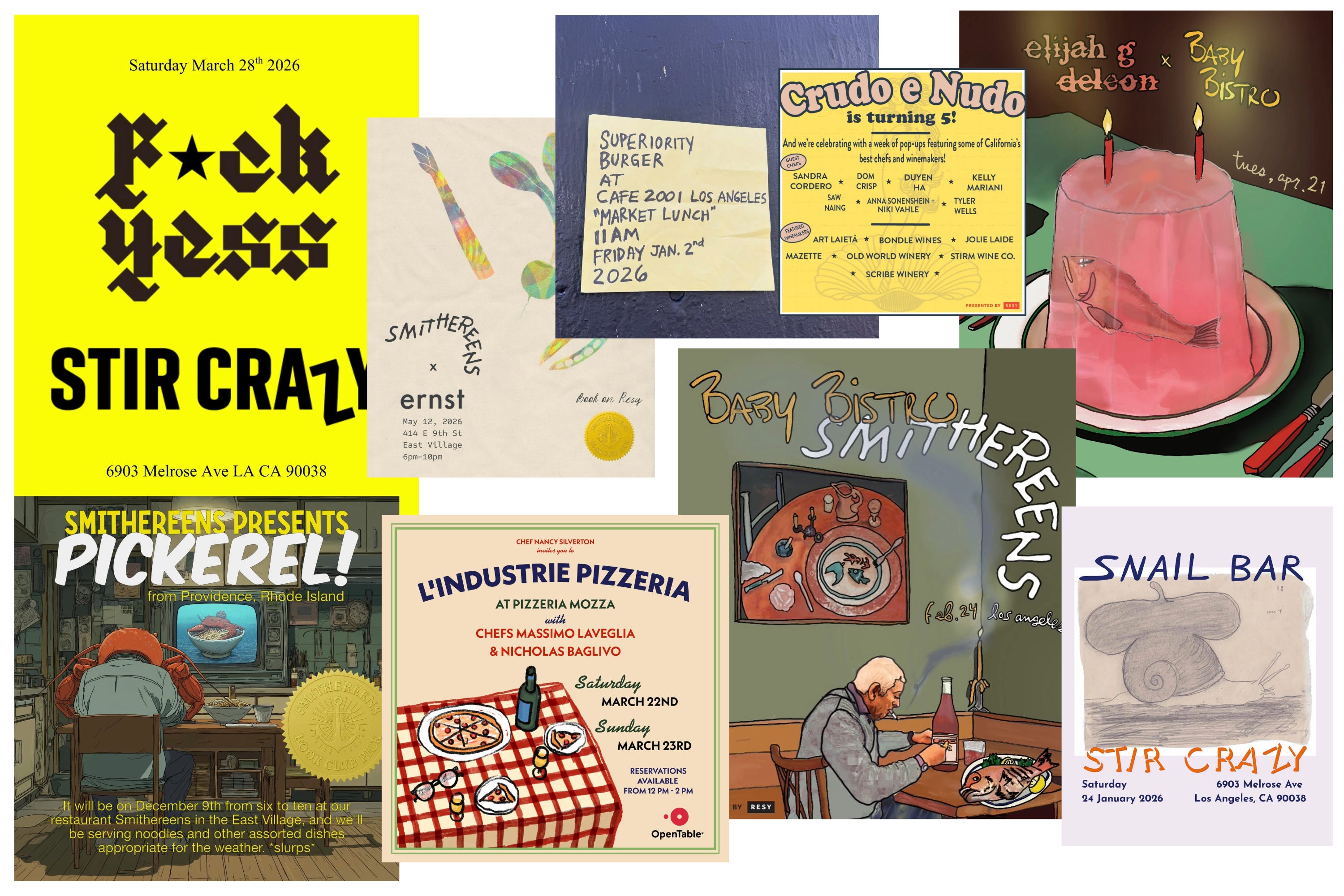

Brooks Headley, owner, Superiority Burger in New York, who has popped up at several restaurants in L.A.: Chi Spacca, the erstwhile Cafe 2001, and a few weeks ago, at Salazar in Frogtown, where he teamed up for a supercharged collaboration with Quarter Sheets, Diego Argoti (Estrano Things), and pastry chef Lo Hoang (Largwa). He’s also hosted several visiting chefs at SB, including Lion Dance Cafe (Oakland) and Salty Lunch Lady’s Little Luncheonette (Queens).
Nancy Silverton, owner, Mozza Restaurant Group, whose collected restaurants have hosted dozens of visiting chefs, ranging from Headley, above, to L’Industrie Pizzeria (New York) to Masala y Maiz (Mexico City) to The Publican (Chicago).
Mackenzie Hoffman, co-owner, Stir Crazy, which has hosted local L.A. restaurants including Baby Bistro, below, and Yess, along with visitors like Rita’s (London); and recently traveled to Ojai to pop up at Pinyon.
Nick Tamburo, owner, Smithereens in New York, who recently popped up at Troubadour Bread & Bistro in Healdsburg and Baby Bistro in L.A.; and has hosted restaurants including Oyster Oyster (DC), Pickerel (Providence), and Locust (Nashville), among others.
Brian Bornemann, owner, Crudo e Nudo, which started as a roving pop-up before finding a permanent home in Santa Monica. The restaurant recently celebrated its 5th anniversary by hosting a weeklong pop-up series with visiting chefs and winemakers, including the teams from Little Fish (L.A.), Betsy (Altadena), and Scribe Winery (Sonoma), among others.
Andy Schwartz, co-owner, Baby Bistro, which began life as a pop-up at L.A. restaurants including Normandie Club and Dudley Market before opening in Victor Heights last year. Since opening, they have hosted visiting chefs like Tamburo, above, and Elijah DeLeon of Rustic Canyon (L.A.), and have popped up at other venues such as Snail Bar (San Francisco).
These interviews have been edited and condensed for clarity.
The Angel: Pop-ups sure seem like a lot of work. What’s the appeal?
Brooks Headley: Well, first thing is, I despise the word ‘pop-up’ [mimics vomiting noise]. I just call them events. And I like to do them because I learn a lot. Whether people come to SB or I go to other places—if you don’t learn something, like one really good thing, then what’s the point?
Nancy Silverton: Strictly from a business perspective, all of us in the struggling restaurant world are constantly trying to figure out ways of bringing business or attention to our restaurants. Whether it’s just business or it’s just attention, pop-ups are something to talk about.
Some collaborations will involve situations where I get so excited about eating the food at a restaurant and I have this unquenchable thirst to share these discoveries. I taste a bite at Masala y Maiz and I’m like, I need to bring that to L.A. And what that trickles down to is: an opportunity for our staff to learn and get excited by somebody else’s food, for our customers to be able to share in those flavors, and for more marketing opportunities. There’s really no end to the benefit.
“Pop-ups are basically another opportunity to either travel somewhere and learn in someone else’s kitchen or bring someone to yours.”
– Nick Tamburo
Mackenzie Hoffman: The benefit first and foremost is staff retention and excitement. The joy and pride that the team gets by hosting is really cool—I quite literally see them showing up with their laces a little bit tighter, they’re buttoned up a little bit more, and they want to show off. They want to host, and make sure that they’re providing the visiting team the utmost respect and support.
Each one of these pop-ups turns into this convivial, communal party of sorts…I think it generates excitement, generates community, generates trust, and just makes our community a little bit bigger, and smaller at the same time. More friends, if you will.
Nick Tamburo: The main thing is just being able to connect with these people and learn from each other. When you’re a younger cook, you can stage in someone else’s kitchen to keep learning, or go work somewhere else. But when you’re later in your career, pop-ups are basically another opportunity to either travel somewhere and learn in someone else’s kitchen or bring someone to yours. There are definitely techniques or ideas on our menus that are inspired by some of these visiting chefs.
I mean, this is, you know, why we get out of bed in the morning—to do stuff like this.
How do you decide who to collaborate with? Is it born from organic, mutual desire, or is there a matchmaker component from an external party?
Brian Bornemann: [For the birthday pop-ups], I had a bunch of chef friends already in mind to reach out to, who were already connected to the space so it felt organic and not forced... In general, I find, if it’s another chef who has a restaurant, and you can collaborate on a menu for a day and you guys get along enough to communicate well, [pop-ups] are a good way to lighten the load, and just hang out and drink wine and talk shop, which is really half the point.
Tamburo: There are a million different ways these things come together. Sometimes I reach out cold to a chef I’ve always admired but never met [which was the case with Dylan Watson Brawn of Ernst, who recently visited from Berlin]. Others are more organic—the one we did with this ramen shop in Providence called Pickerel happened because their owner, Scott, came in to dine at Smithereens a bunch of times. We got to talking, he’s a cool dude, a great guest, so we decided to invite him down… What we’re really looking for is someone who’s going to complement what we already do, or someone that we’re inspired by and want to learn from.
Headley: We make sure we only invite people that we either love as people or we love their food. We don’t do anything in between. I wouldn’t do it for somebody who I didn’t know, or somebody whose food I don’t love. We’ve done it for a lot of people whose food I love, and sometimes we’ll do it for people I love even if I’m not that crazy about their food, but that’s rare.
Let’s talk about the logistics of pulling off a pop-up: you have one restaurant essentially invading another one’s space, bringing unfamiliar people, ingredients, and ways of working, for a meal you only get one chance to pull off. How do you ensure things don’t go off the rails?
Andy Schwartz: We have a tiny space. We really only have room for one other person on the line, and no one else in the front of house. And we cannot do something where the guest suffers. So now we have a system, a format. One chef comes, they collaborate with [chef and co-owner] Miles [Thompson], they get to represent their restaurant and their food, and we fold it into our exact style of operation… If we had to remake the restaurant and service in order to give the level of service that we want to give, it would not be worth it.
Hoffman: I approach it like I do any sort of private event, which is a lot of planning, so that execution is very seamless. There’s a lot of information exchanged in the beginning… I appreciate a lot of collaboration beforehand to get on the same page, because everyone is so invested in this, and neither person really comes out winning financially [Editor’s note: more on this in a minute]. We do a lot up front to make sure everyone feels super confident and very comfortable when the actual day comes, because there’s nothing worse than you having one shot and it going off the rails.
Tamburo: We usually split the menu. We’ll ask the guest chef to contribute four to six dishes, then we’ll plan our dishes around that to make a balanced menu. And we’ll give them first pick of ingredients, so we don’t have, like, multiple asparagus dishes.
I think both parties have to go into it with the right spirit, or it can be a little trying. When Locust came, it was so fun and celebratory. They brought almost their entire team, and a lot of their equipment, plus costumes and masks to wear during service… To make one of these happen, logistically, it does involve a lot of work on both parties. But if the excitement is there, then it makes it a lot easier.
If you’re hosting the pop-up, is there anything you can do to make it easier on the visiting restaurant?
Headley: I make sure that if a restaurant is coming in from out of town, we take fucking care of them. We make sure any help they need, we do it. You want us to make all your food? We’ll make it. Do you want us to make part of your food? We’ll do it. I want them to come and have an excellent time. I don’t want them to have to work the line—I want them to work the room, have fun, and make sure it’s a great experience, because I’ve had many experiences where I’m doing events elsewhere and they couldn’t care less.
“I don’t want them to have to work the line—I want them to work the room.”
– Brooks Headley
Silverton: I do feel responsible to be in town when these collaborations go on, so I never schedule them when I’m not and I never make plans when I know somebody is coming. I think it’s so important to be a host. I am with them to make sure that their experience is as positive as possible, with all the support that they need. I love to curate food from around the city that they might be interested in tasting, whether it’s a Langer’s pastrami sandwich or a burrito from Burritos Las Palmas. Whatever we can to make the experience memorable on their end and make them feel that they’re not just here to work hard.
I want to understand if there’s a financial benefit to either side for a pop-up. Who’s paying for it, and is anyone making money off of it? Who’s covering travel, food costs, and labor? And how do you divvy up the revenue from your event?
Silverton: There’s a phenomenon happening in the restaurant world right now, in which credit card companies and reservation platforms are very competitive [...] and they’re offering all sorts of opportunities to attract and retain customers. They’re offering huge dollar amounts to join them, but they’re also offering to support events such as bringing in restaurant tours from around the world. So we’re using those available dollars to help market our restaurant.
The visiting chef does not make money, and they know it, but they’re there to market their restaurant, or they want the excuse to come to L.A. They get their travel paid for, they visit a new city, and we always give a food stipend, so they’re not leaving poorer than when they arrived.
Bornemann: There are a million ways to split it up, but here are the main two: As the visiting chef, you show up with everything and manage your own food costs and do all of your own purchasing and labor. You get the place that’s hosting to give you a check for all of the food sales minus sales tax, and then you do the math. I spent 900 bucks on product, I made $2,000 in sales, easy. Another way is: you work with the hosting restaurant and say, Hey guys, I don’t want to lug anything. Let’s order these ingredients. Let’s put together this prep list, and when I show up, I’ll expect these things to be here in this condition, and I’ll do this part and we’ll do that part together. In that case, the host orders all the product, and keeps all of the revenue, but they might agree to pay you a chef fee.
[For the anniversary pop-ups] I was lucky enough to get Resy/AmEx to help cover the chef fees… I think if you’re a credit card company, if you’re able to make some good noise for your cardholders with an event, and all it takes is, here’s a few thousand bucks, that definitely helps.
Hoffman: For us, basically, all food sales go to the visiting team, and we keep all of the beverage sales. If we have to do some heavy lifting with ordering beforehand, I might take away the cost of goods. And based on a couple of other variables, I have charged a small “operational fee,” which accounts for things like credit card processing fees, linens, water, and insurance. But for the most part, they get 100% of the net food sales and we keep beverage.
Tamburo: The most traditional format I’ve seen is that the host restaurant covers the traveling costs for the visiting chef, and all the food costs, and might be able to provide a small stipend for the chef. Then they keep all of the sales. So the visiting chef kind of just gets a free trip out of it.
Headley: The point is not to make money. I mean, maybe some people make some money on them. I usually don’t. It is nice to get paid back for them. But I am also totally willing to do a pop-up where I get no financial reward from it. It’s just another kind of reward.
Done a few of these with Bridges now so:
The most underrated upside is what it does for your team. Kitchen picks up new techniques, FOH sees a different service flow, and the relationships between the two teams tend to stick around after. We've had people stage at partner restaurants off the back of it. We always try to bring a dining room person too so both sides actually get something out of it.
The communication weeks leading up to the event is everything btw. That's the difference between a morale boost and a mess.
Brand-wise — bringing James Henry and Brat over in our early days did more than most press placements by cross-posting on socials. And most visiting chefs want the New York moment anyway, so the motivation is usually mutual.
Economics can also be surprisingly strong depending on how you structure it and who your partner is.
brb sending this to every publicist I know.