


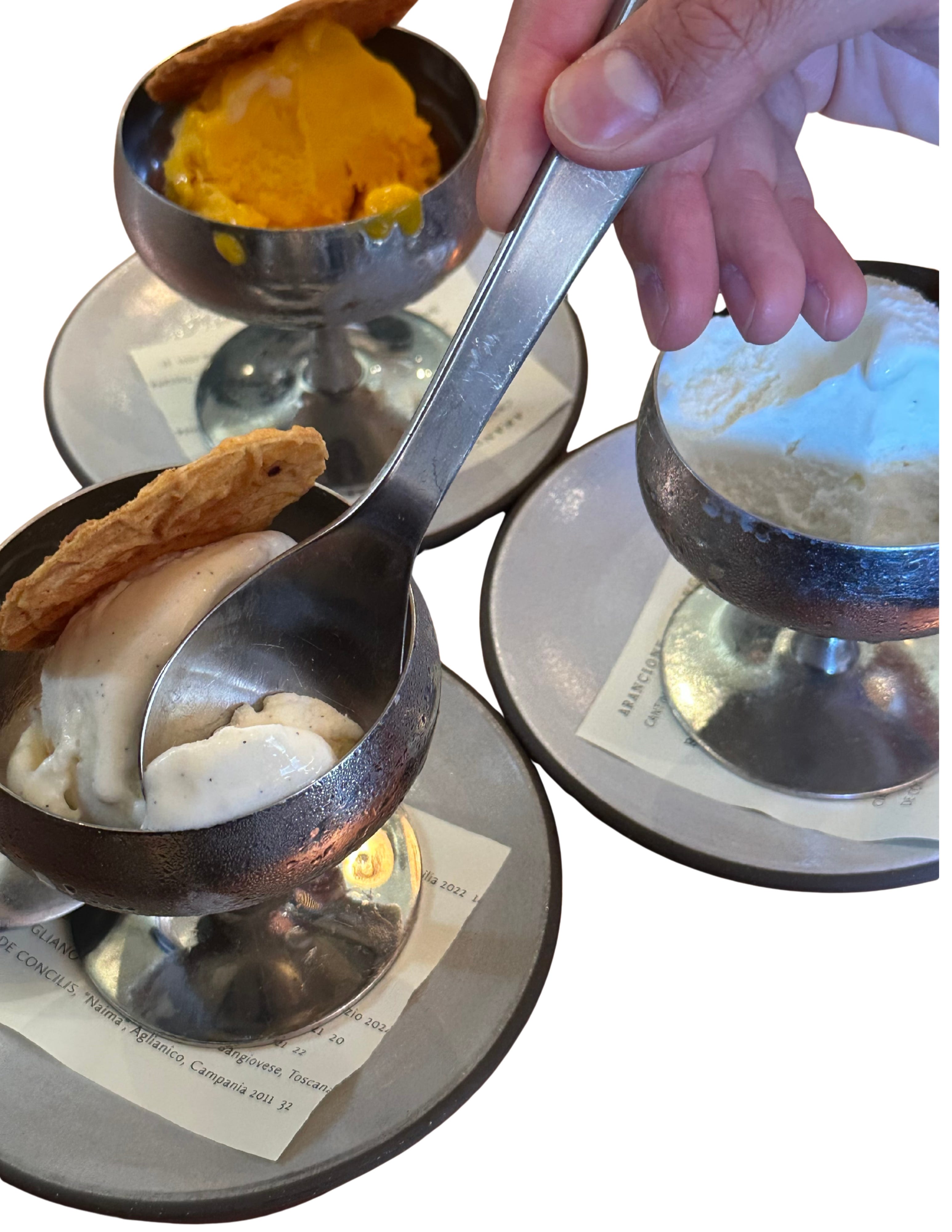
This summer promises rolling heat waves from Paris to L.A., and, naturally, New York (where we just survived one—or did we?—last week). It’s hard to drum up an appetite in this kind of weather. Unless it’s for ice cream: soft serve dunked in a chocolate shell, procured from a jingling truck; a pint of Cherry Garcia from the bodega; scoops of brambleberry crisp and black sesame from the fancy ice cream shop; and, best of all, restaurant ice cream, served in steel coupes or sundae glasses.
In restaurants, ice cream often plays a supporting role on the dessert menu, as a component that completes a plated dessert. But some pastry chefs give it room to shine on its own, offering a few scoops (or more) for diners to choose from at the end of a meal, with flavors that rotate by season and the whims of the pastry team. I’m here, today, to tell you that when you see ice cream centered on a dessert menu like this, you should order it—maybe even instead of the silky tiramisu or apricot tart—because ice cream made by ace pastry chefs at sit-down restaurants goes light years above the listless, over-processed dreck you’ll find lurking in the freezer aisle.
The other, more obvious case to be made for ordering ice cream in restaurants is that it’s somewhat light and definitively cold, and thus particularly refreshing on a hot summer day. As Quarter Sheets’ Hannah Ziskin, an ice cream lover and skilled practitioner of the form, once told me: “It’s just perfect. It’s not too heavy, you can eat the whole thing… It’s something that lightens instead of depresses your stomach at the end [of a restaurant meal].”
As a hobbyist ice cream maker myself, I know firsthand the pleasure of freshly churned ice cream made with organic local dairy, pastured eggs, and peak-season farmers’ market produce—a pleasure that, if you don’t make your own (fair, though I’d invite you to join the club), you can really only find in restaurants, not scoop shops, ice cream trucks, or freezer aisles. For this story, I spoke to a number of pros to prove why.

Ice cream is frozen, so it keeps, but that doesn’t mean month-old ice cream tastes like the freshly made stuff. Ed Cornell, a seasoned restaurant ice cream maker and co-owner of Café Tropical in L.A., told me that at scoop shops, he always orders the most popular flavors—the ones that move in volume, like cookies and cream or chocolate—since they’re less likely to have been sitting in a tub for months.
Commercially made ice cream also tends to contain stabilizers, such as guar or xanthan gums, to slow ice crystal growth, improve texture, and extend shelf life. Stabilizers aren’t inherently bad—they’re what let you eat a cone slowly without it melting down your arm—but they can mask flavor, affect texture, and cause digestive discomfort.
“The fact that [ice cream in restaurants] is usually churned the day of means that they don’t need as much stabilizer as commercially produced ice cream,” says Claudia Fleming, the executive culinary director of Union Square Hospitality Group’s Daily Provisions, and the author of the dessert-centric cookbooks The Last Course and Delectable. “Also, the freshness means the intensity of flavor is more pronounced, because when things freeze, flavor tends to dissipate.”
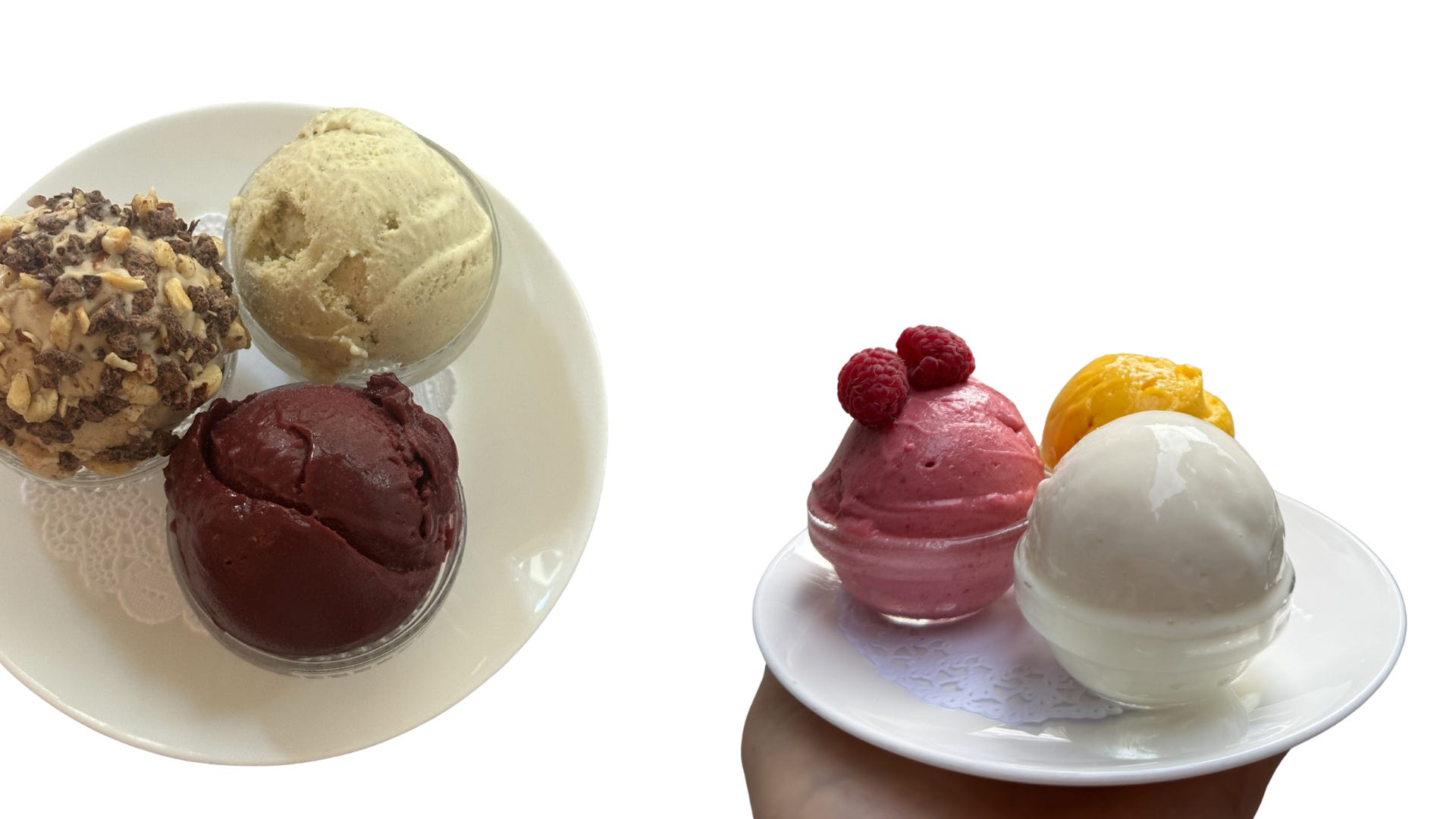

Pastry chefs, with their access to high-quality ingredients and their obsession with maximizing flavor, tend to produce highly potent ice creams.
Stephanie Prida, the pastry chef at Bar Chimera in Midtown (formerly The Grill, Manresa), makes a vanilla that goes far beyond a typical scoop: “I use a shit ton of vanilla beans, way more than I should, and I also marinate sugar in vanilla beans, then pulverize the beans afterwards, and let them sit overnight [in the ice cream base], so there’s so many different layers of vanilla,” she says.
For Clodagh Manning, the pastry chef at Zimmi’s in the West Village (formerly Lyle’s, in London), distilled, specific flavor is the cornerstone of her approach. “I really like ice creams that taste like the thing that they’re based on, rather than just a faint suggestion,” she says, adding that a restaurant setting is conducive to this style: “Because you’re eating [ice cream] in smaller volumes, they can be more charged with flavor.” At Zimmi’s, she regularly offers a trio of ice creams; her favorite, on the menu last fall, paired Concord grape with a boozy vanilla made with an excess of beans and a toasty hazelnut tossed with chunks of chocolate. “It read as a really luxurious PB and J combo,” Manning says.
“I remember having this epiphany while eating cheapo roadside soft serve, nothing special. I kept eating it and I kept eating it and I kept eating it, waiting to get satisfied, and it never happened. It was just a lot of air, and not very good flavoring… I find that when you have a richer ice cream, you just need a small amount to satisfy.” –Claudia Fleming
Fleming crafted the opening dessert menu at Ci Siamo (a Union Square Hospitality Group restaurant), channeling the Italian ethos of ingredient-quality fanaticism and concentrated flavor. The resulting scoop menu features a satiny dark chocolate sorbet and a deeply buttery pistachio gelato. “I remember having this epiphany while eating cheapo roadside soft serve, nothing special,” she says. “I kept eating it and I kept eating it and I kept eating it, waiting to get satisfied, and it never happened. It was just a lot of air, and not very good flavoring… I find that when you have a richer ice cream, you just need a small amount to satisfy.”

The odds of finding greengage ice cream or Tristar strawberry sorbet at an ice cream parlor are slim to none, except at certain cheffily-minded scoop shops. At restaurants, especially those with hyper-seasonal ambitions, they’re good. “You can put a dish on for a little bit, then take it off,” says Manning. “And instead of selling a pint or a giant scoop on a cone, you’re selling a [smaller portion], so that unlocks more potential of interesting or rare flavors, where you get one batch of, say, mulberries, and make ice cream out of that.”
Come late summer, she’s looking forward to making damson ice cream from the tiny, tannic plums commonly used in the UK but harder to find in New York (she sources hers from the Union Square Greenmarket).

Finally, many of the pastry chefs I know are technique-driven brainiacs who love to go the extra mile. At Zimmi’s, Manning has been making ice cream with cherry pits, infusing the dairy with the kernels to extract their almondy flavor, then pairing it with a cherry dessert. “Those kinds of flavor pairings are so satisfying to me: the fruit with the flavor of the seed from the fruit. It’s like whole animal cooking, but the dessert version,” she says.
“Those kinds of flavor pairings are so satisfying to me: the fruit with the flavor of the seed from the fruit. It’s like whole animal cooking, but the dessert version.” –Clodagh Manning
One of Prida’s staples is a zero-waste frozen yogurt that takes four days to make: “I make my own yogurt, put it in the oven overnight, then cool it down and press it. The next day I turn the whey into a whey caramel, and churn the fresh yogurt into frozen yogurt,” she says.
Meanwhile, David Lebovitz, author of the ice cream bible The Perfect Scoop and the former longtime pastry chef at Chez Panisse (who now lives in Paris), recently made a Chartreuse ice cream studded with vegan chocolate marshmallows, “which blew a few French minds,” he says — “But everyone ate it.”
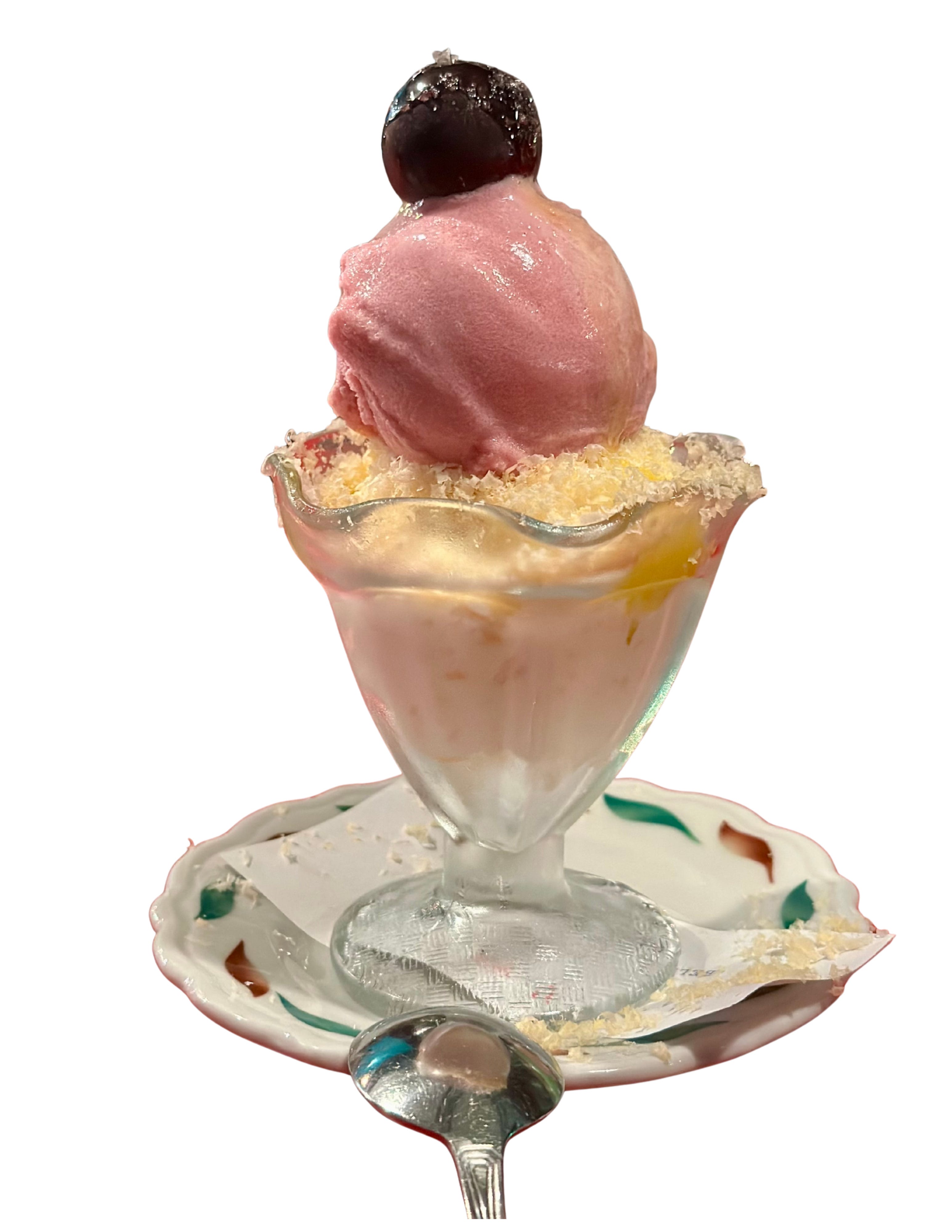

As a bonus, I asked a handful of my favorite ice cream makers—David Lebovitz, Kitty Travers, Claudia Fleming, and more!—for the single most memorable scoop they’ve ever had. Here’s what they said:
