


Sometimes, I look at the wear on my favorite wooden spoon in awe.
“Just look at the bend halfway down the handle!” I’ll exclaim to myself, admiring the patina, which I proudly inflicted on it myself, over seven years of daily use.
Erosion of any kind is an affecting thing to behold, and in the culinary world, it’s ever-present. The erosion on my perfect wooden spoon that dutifully stands at attention in a utensil crock to the right of my home stove; the erosion of pots, pans, and knives that live on the line in the millions of restaurant kitchens across the globe; and the erosion of the body seen in burns, cuts, swelling, and aches of those who farm and prepare the food we eat.
I’ve developed my share of joint issues from working in kitchens, few more pernicious than the ache of my lower back. Which, somewhat ironically, dramatically affects my experience of dining out, especially if the restaurant in question has uncomfortable dining chairs. It started like this—my fascination with restaurant seating—from a purely practical perspective. What seat is the most supportive for a drawn-out dinner? Can I determine cushion thickness from a Google Maps user-submitted photo alone? Why would any restaurateur opt for a Lancaster Alloy Set if they could possibly help it? “Seating can make or break a meal, especially one meant to last for more than 30 minutes,” says food writer Khushbu Shah. “If you are uncomfortable because your hips are jutting into the arm rests, or the back of the chair is so stiff you start to feel your lower back cramp, or the stool is so slippery you keep sliding off, you’re not fully present.”
Most of our time spent in restaurants is spent sitting down (unless you’re at a pintxos bar in San Sebastián). Crafting a space that works with the contours of the bodies that flow through it is an art, with comfort being the obvious first box to check. But what else is to be considered? Think of how many suited Hollywood rear ends have brushed up against the thick red leather of the studded seats at Musso & Frank Grill. Or how many cumulative hours have been clocked on the cushioned banquet chairs at Atlantic Seafood, listening to the clickity clack of dim sum carts circle the room. Think of how many New Yorkers on dates have uncomfortably shifted their weight from side to side in an austere Shaker banquette while pondering another round at The Commerce Inn. The wear we leave on these living pieces of furniture, and the wear they leave on us, is significant, as should be the thought process behind their selection.
In my quest to investigate the very consequential matter of restaurant seating, I spoke with a handful of restaurant owners, as well as other experts, whose choices I’ve admired over my years of dining in New York and Los Angeles. I’ve broken down their insights (and mine) by chair type.

Fit for a king; seating so special and considered that it becomes a highlight, rather than a facet of the dining experience.
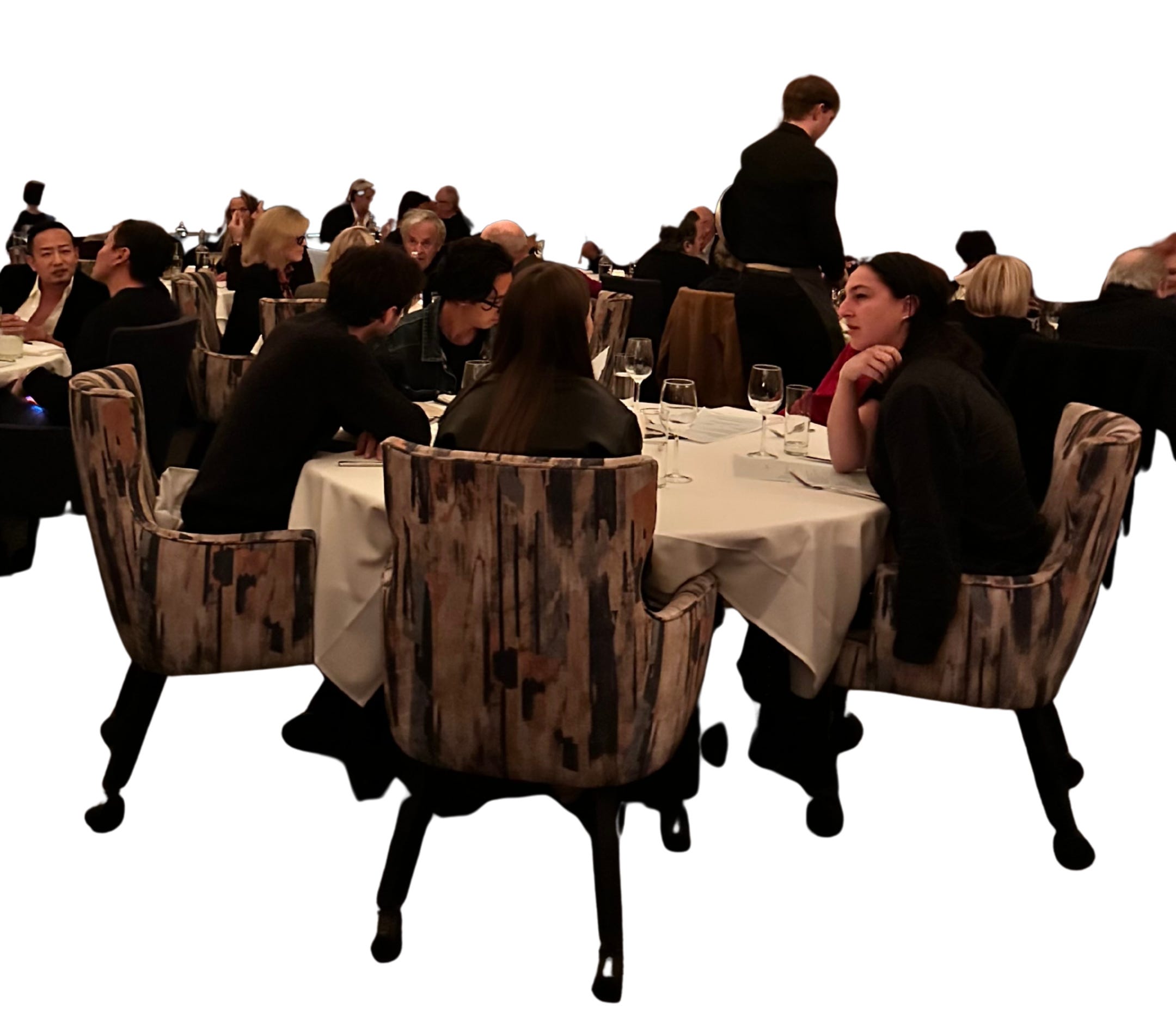
“We wanted the interior to look like your classic chophouse but with a feminine feel to it,” says Suzanne Tracht, chef-owner of Jar Restaurant in Beverly Grove. “Like somewhere your dad would take you when you were little. But I didn’t want those big old red booths, I wanted to think outside the box.” Her answer came during her collaboration with the late Bret Witke, interior designer to the stars: big, plush, deep armchairs…on wheels. Perhaps Witke’s memories of visiting Disneyland with his theme park designer mother and background as a storied club proprietor led to a design choice so equally luxe and whimsical. But no matter the inspiration, the wheeled chairs at Jar (opened in 2001) remain iconic. Their existence compromises neither comfort nor functionality, and should the restaurant book out for a private party or a film shoot, they need only be corralled to the side like a herd of sheep. “Jar is the type of place where customers know one another, so sometimes, yeah, they do roll over to another table. And I always joke that if they’re too full, I’ll wheel them out!” says Tracht.
At Bistro Na’s in Temple City, a different type of throne welcomes diners eager to experience the restaurant’s dedicated interpretation of imperial Manchu cuisine. The seating, carved from dark cherry rosewood in a Qing-style design with satin cushions, matches the rest of the dining room, which is spacious and ornate. The room takes on a museum-like feel, with traditional musical instruments and intricately engraved wooden beams lining the perimeter. Here, the seating is a reminder that the food you’re eating has its origins in royal banquet halls; the chairs follow suit, deeming every guest a member of the court.
“Jar is the type of place where customers know one another, so sometimes, yeah, they do roll over to another table. And I always joke that if they’re too full, I’ll wheel them out!”
— Suzanne Tracht

Seating built for two or more, cushioned or otherwise (I’m looking at you, banquettes).
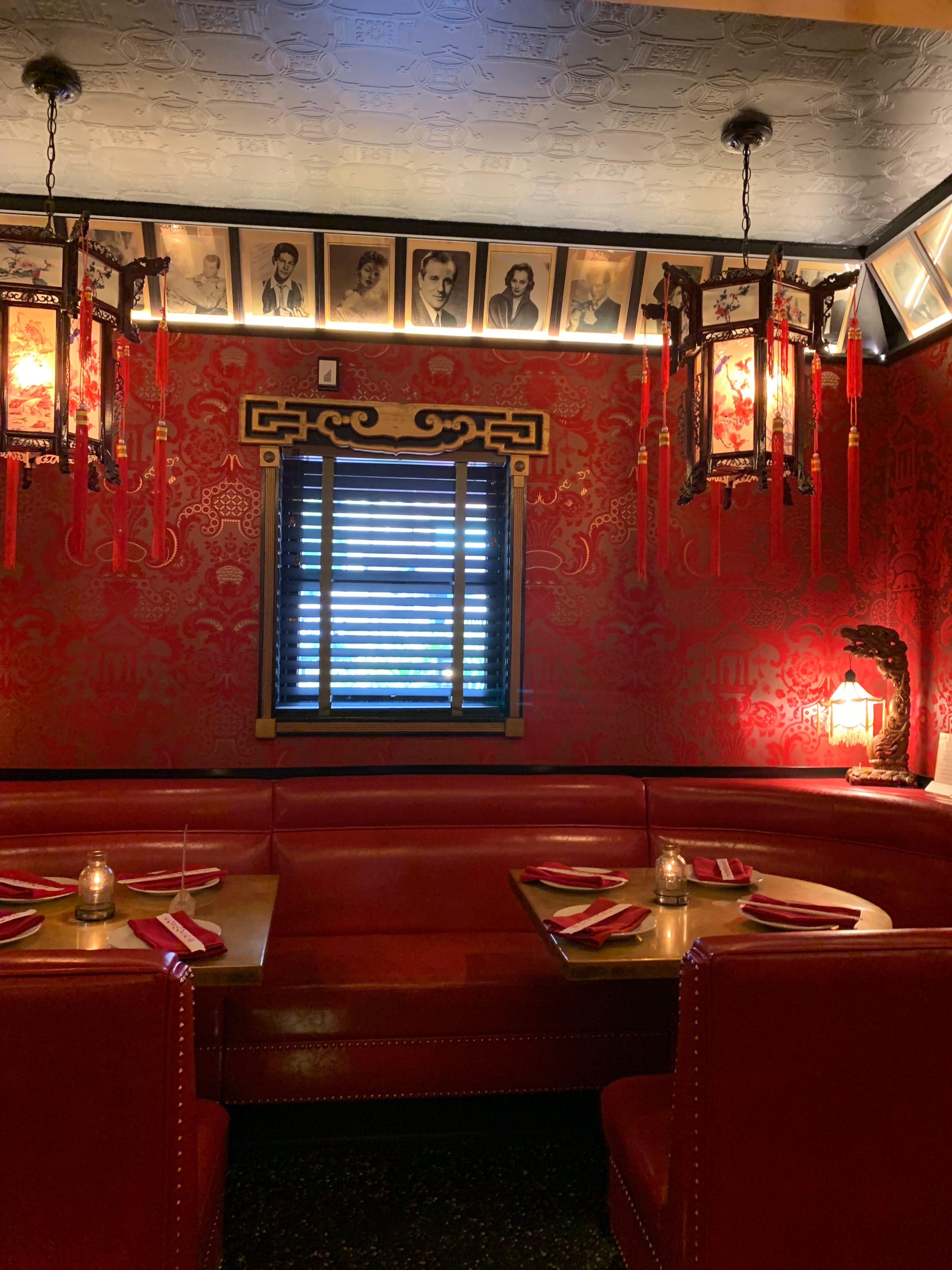
Draw a map tracing the red leather booths in and around L.A. and you’d wind up with something that looks like a beating heart, veins and all. New York City’s map would be less veiny, but similar. While few booths are as renowned as Musso & Frank Grill’s red leather hideaways, many named for their corresponding starlet (Charlie Chaplin’s booth faced the street so he could allegedly keep an eye on his horse), the list of storied red seating is long and cuisine agnostic. One can dine on spaghetti and meatballs at Colombo’s or La Dolce Vita, jap chae at The Prince, walnut shrimp at Formosa Cafe, and chile rellenos at Casa Vega—all from the comfort of a red leather booth.
A booth, if not at a diner, tacitly admits your establishment is, at the very least, trying to be sexy. Sometimes that admission grows to a yell. You’d think spherical space age booths would have been enough for the Westin Bonaventure’s rooftop Bonavista Lounge in 1977, but—call it pre-Olympic jitters or a downtown revitalization effort—the whole floor was hooked up to a motor and set to rotate over the then-growing Los Angeles skyline. The Dresden’s back dining room sports a series of witchy white leather booths and chairs embossed with a massive “DR” monogram—very ‘80s, although the restaurant and cocktail lounge has been a fixture of Hillhurst Ave since 1954.
“I like a really tight little booth where knees are all folding together uncomfortably at first, and then you stop really noticing,” says Andy Schwartz of Baby Bistro, whose interior couldn’t be anything further from classic kitsch, down to the wood banquettes. “I’m specifically thinking about HMS Bounty’s corner pocket,” he adds, referring to the booth in the back left corner of the nautical-themed Koreatown dive bar, a favorite haunt of the late Anthony Bourdain. At Schwartz’s own restaurant, the interior design was largely dictated by the original structure, a Victorian house constructed in the early 1900s. “When we got the space, it was just white walls and this old Doug fir subfloor, and we wanted to honor that as much as possible, so we sourced a bunch of old-growth wood and milled it down, then [artist and designer] Grayson Revoir went about laying the floor and building tables, shelves, speakers, window frames, baseboards, and banquettes.”
Could a banquette be the booth’s perfect foil? Or maybe its sophisticated older cousin? The two nurture the same type of closeness with varying levels of restraint.

Chairs built from wood, from the deepest depths of an old oak forest to the farthest reaches of the Webstaurant website.
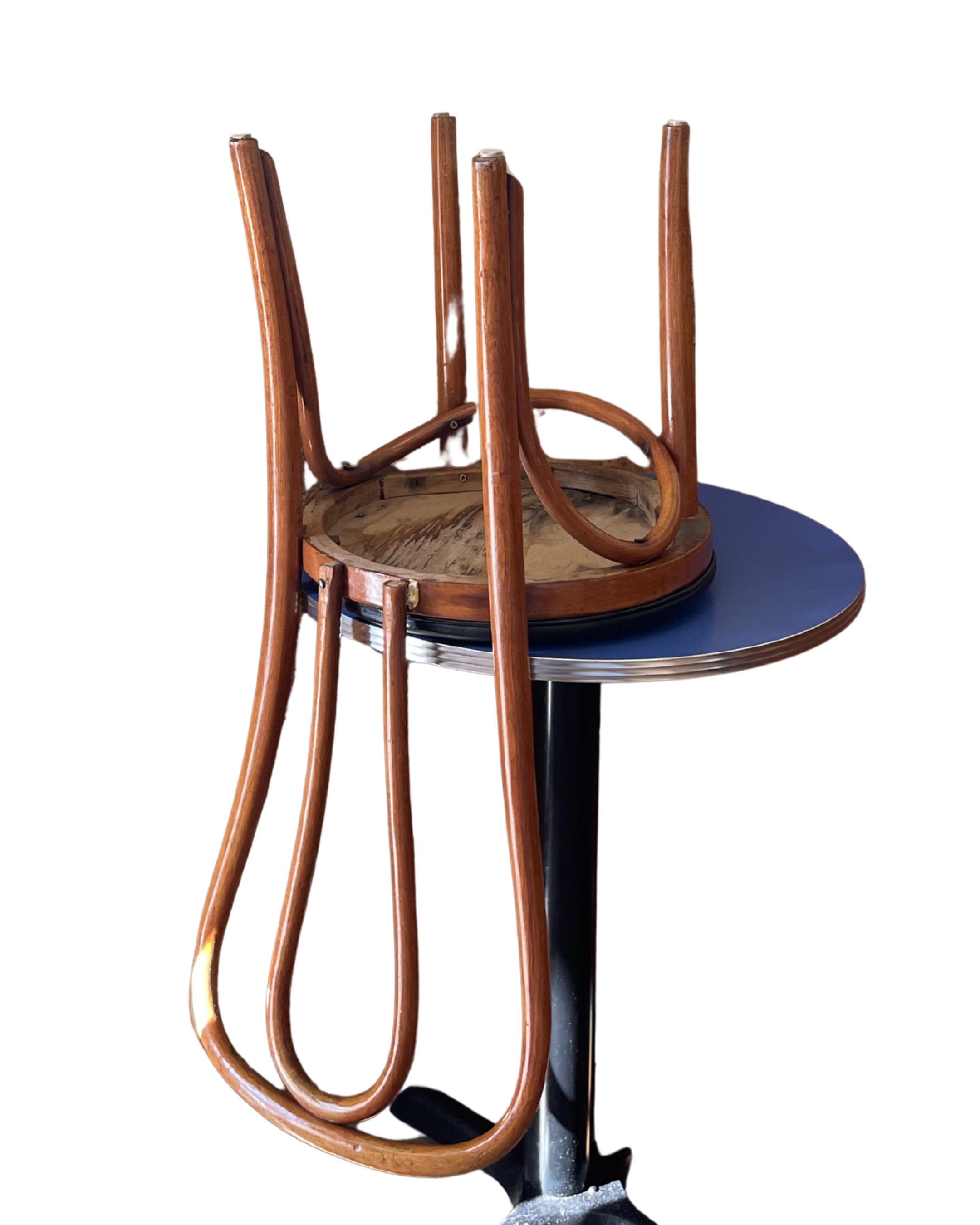
The Vienna Chair, found in restaurants like Cafe Mogador (East Village) and Sam’s Place (Highland Park), may be the king of this category; anything that maintains design relevance after 167 years deserves such a title. You’ve seen Vienna chairs in bistros and on back patios—they’re lightweight, easily stackable, and reasonably comfortable for prolonged gathering. Other less dominant examples of wooden restaurant chairs include splay-legged Windsor Chairs, midcentury-style with their low curved backs, and clunky Shaker schoolchairs a la Ukrainian East Village Restaurant or Philippe The Original—an obvious choice for operators looking to invoke a sense of American nostalgia.

Otherwise known as… plastic chairs. As ubiquitous as they are necessary.
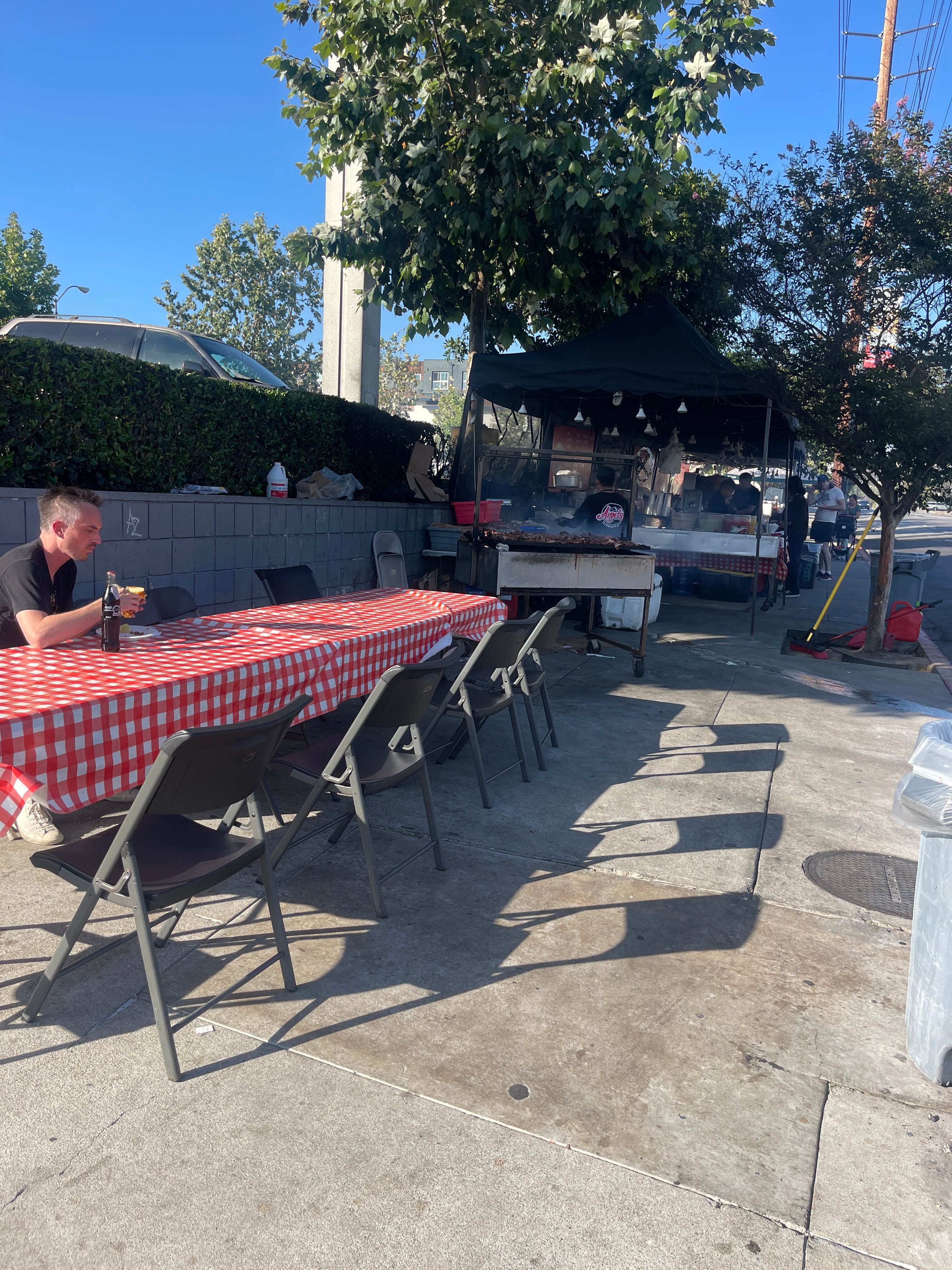
I’m no Bryan Ropar, but I know my way around a plastic chair. I like folding chairs specifically, no armrests, who needs them? If you’re sitting in a plastic chair, your arms should be occupied with something handheld and delicious. It would seem that this chair archetype reigns supreme in Los Angeles. They dot the sidewalks beside taco trucks and pupusa stands, and stay propped up in the backyards of MEHKOs, such as Comedor Tenchita and Mariscos El Chito. It’s not unlikely to find chairs with price tags and stickers still on them plopped next to a spit or a flame. The plastic chair represents ingenuity and hustle. In the case of Angel’s Tijuana Tacos, these chairs turn into hot commodities, quadrupling in value during the busy hours as customers search for somewhere to prop their plate; at the Eagle Rock location specifically, tables are fashioned out of just about anything in the busy neighboring Target parking lot. Then, at midnight, much like a carriage into a pumpkin, they return to their original form.
These chairs turn into hot commodities, quadrupling in value during the busy hours as customers search for somewhere to prop their plate…Then, at midnight, much like a carriage into a pumpkin, they return to their original form.

Often backless seating with little to no arm support. Sometimes up high, sometimes down low, rarely in the middle.
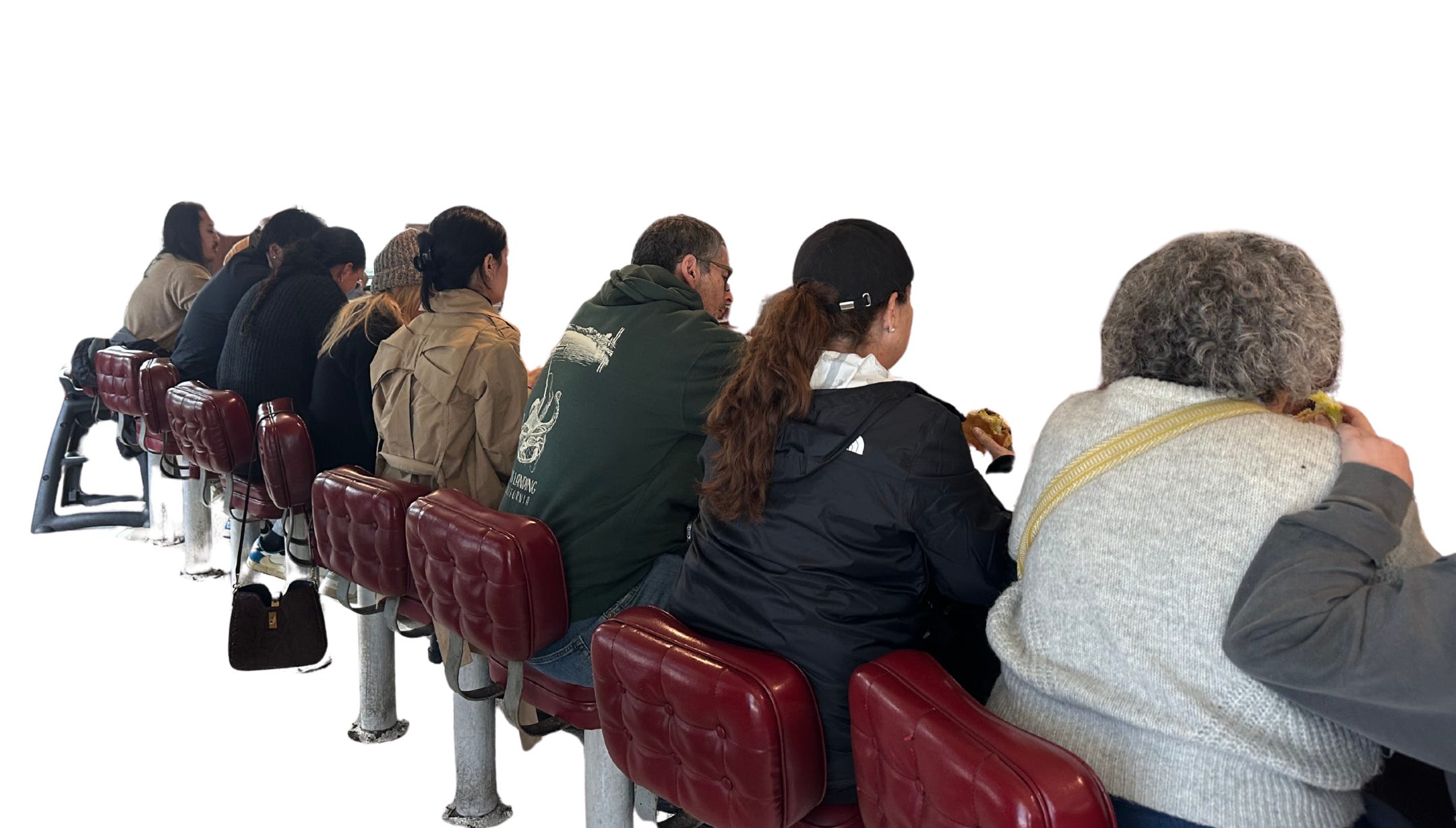
Bar seating is polarizing, and for good reason. Bad bar seats, of which there are many, can feel like balancing on the head of a pin. But when mastered, they are the most intimate in the house, offering an eye to the action. Shah loves the bar seats at Hermon’s, Last Word Hospitality’s latest edition to the Eastside heatmap: “Foot rest on the stool, foot rests under the bar, backing on the stool, easy to climb in and out of, and they are plush.”
Further noteworthy classic and comfortable bar seats include The Apple Pan’s red leather variety with a short supportive back panel and a hook underneath the bar to hang your belongings; Grand Central Oyster Bar’s high-backed swivel seats, mounted to the floor on a circular silver column and boasting a front row view of the perpetual shuck; and El Colmao’s forest green stools that barely levitate off the ground.
But bar seating does not make up the entire category of stools. Take the plastic, brightly colored Vietnamese variety, an ultra-recognizable symbol of the country’s hospitality. In the late 1800s, when French colonization led to an influx of paved roads, stools and benches became more popular than woven mats due to their comfort and practicality. To this day, they are the preferred vehicle for eating low to the ground and close together, ideal for sharing and talking throughout mealtime. In the late ‘80s, during a surge in plastic production, lightweight, waterproof versions of these stools emerged en masse. Easily stackable for transport or potential street ordinances, these stools can be found far and wide in Vietnam and on a small section of Forsyth Street at Mắm, where hungry New Yorkers adopt a new posture, eagerly munching on crispy blocks of housemade fried tofu and elegant stuffed snails.

These seats are novel, exciting, and sometimes the sole reason to eat out (RIP Myrtle Ave Burger King Taxi-shaped booth).
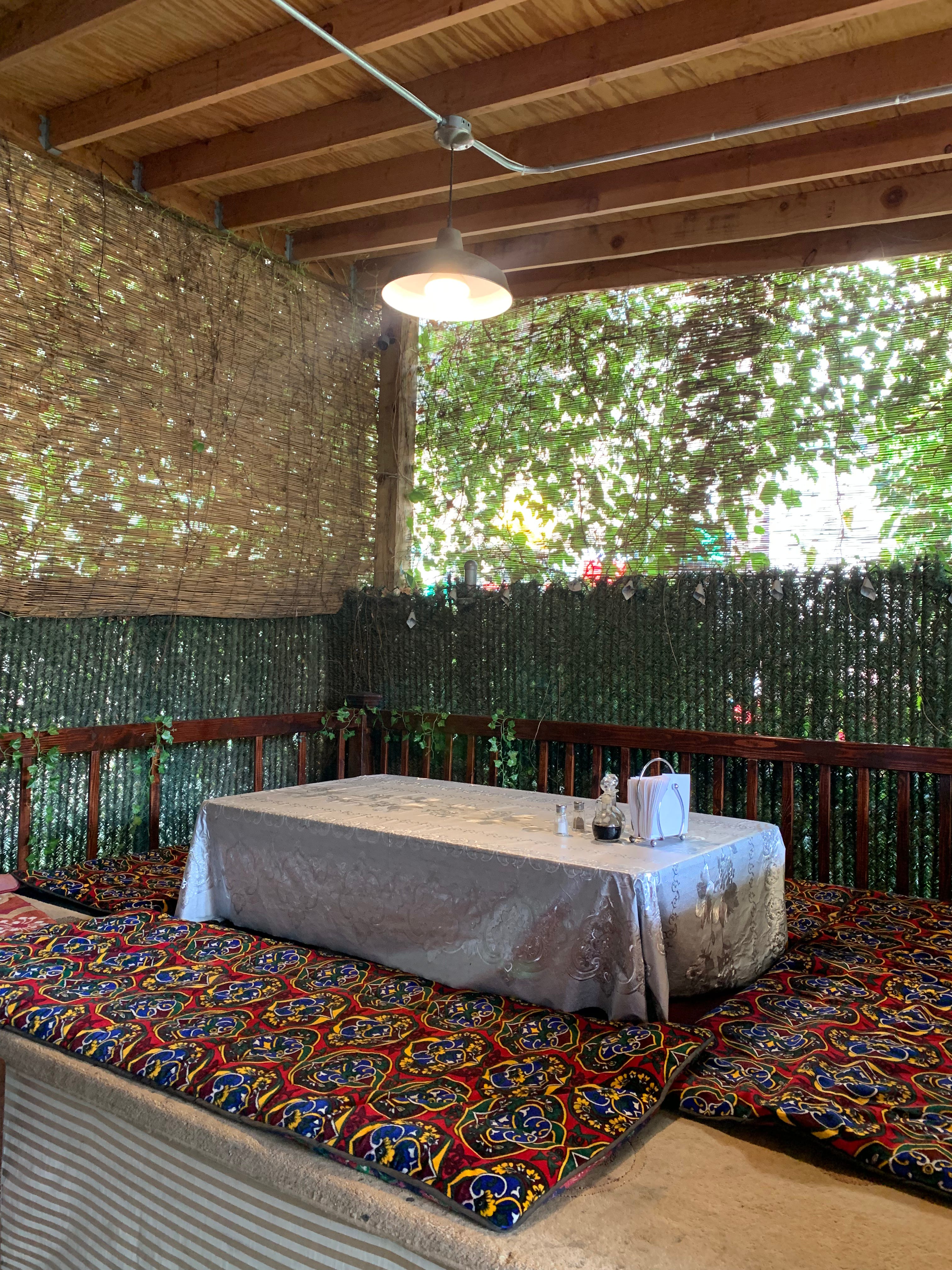
At Cafe Lily in Bensonhurst, the best seat in the house is in the back garden. There, under a wooden canopy, sits an Uzbek tapchan, draped in jewel-toned, patterned textiles. A tapchan is a multipurpose piece of raised furniture, part table, part bed, dressed with a thin mattress (or thick blanket) known as a kurpacha and comfortable pillows. Cafe Lily serves dishes that are Koryo-saram, ethnically Korean but from Uzbekistan. As you recline into your lunch, new patterns emerge on the tapchan’s surface, composed of plates of food: plov, kimchi, the tangy carrot salad known as morkovcha, and manti the size of the pillows propping you up.
For a flicker of childhood nostalgia, or just a moment of respite from New York’s Chinatown bustle, duck into Lucky King off Grand Street and pop a squat in one of their dining chairs, each shaped, sized, and colored like M&Ms. They are as delightful as they are uncomfortable, but the good news is you need only to sit in one for the few minutes it will take you to devour a flaky egg tart or chewy sesame ball. Unfortunately, these chairs are welded to the tables in front of them. The owners must’ve gotten word of my plan to make off with a few for my own home and decided to make the necessary arrangements.

Love this piece. The vienna/thonet is my least favorite restaurant chair of all time. Keith McNally copycats ruined Tolix, but when he put them in Schiller's, it felt revolutionary.
love this a lot