


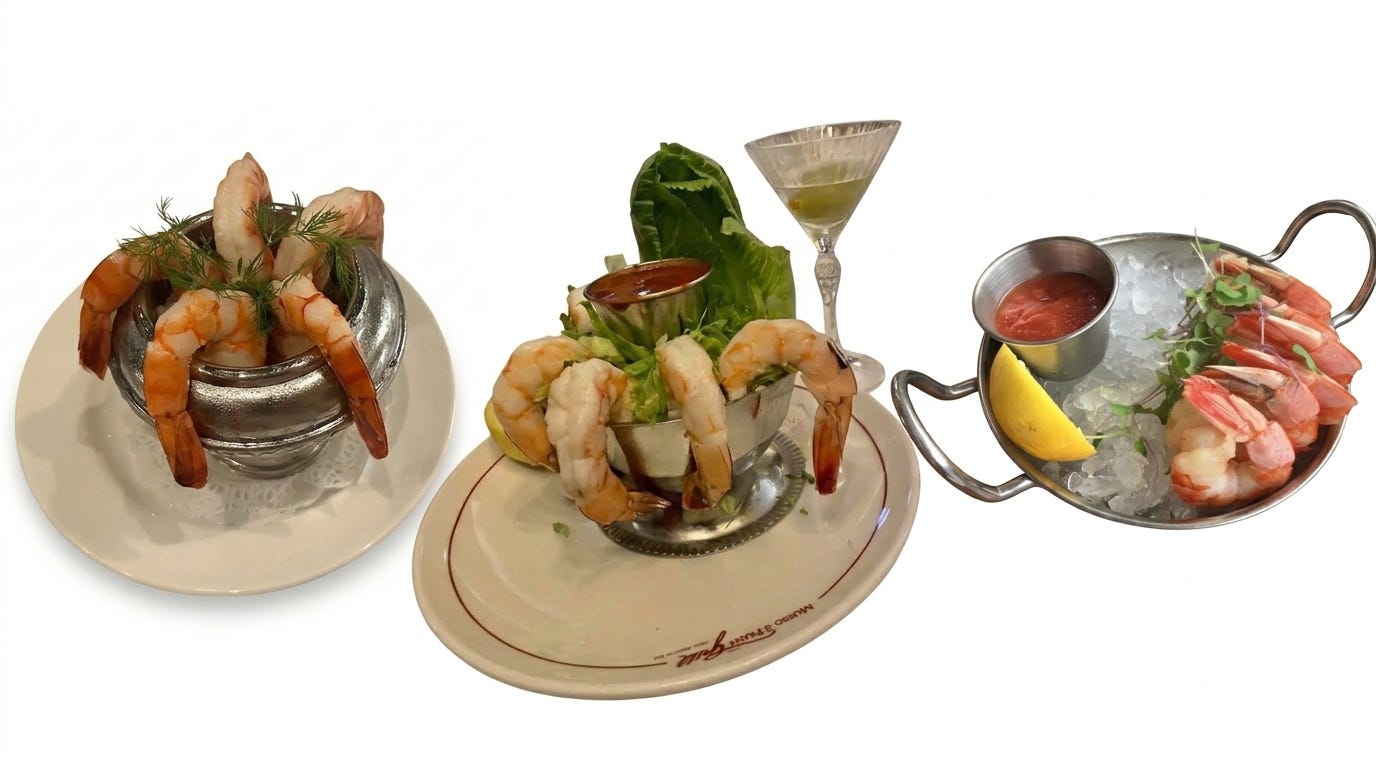
A few weeks ago, I was catching up with a friend at our neighborhood raw bar. We’re both food people, so sharing plates is our default, no encouragement from the server required. We ordered some oysters, an aguachile, and a shrimp cocktail.
I love a good shrimp cocktail, as does Emily, who once called it “a perfect dish.” But when this cocktail arrived, my heart sank. Not because the shrimp looked bad (the shrimp looked great!). But because the shrimp looked, undeniably, like five.
Five shrimp.
For two people.
Who are sharing plates.
Now, I’m a writer, which means I’m constitutionally unsuited to math. But if I’m dividing things correctly, that nets out to two whole shrimp per person, plus a half shrimp each. Have you ever tried to split a single shrimp? It’s extremely awkward. It’s arguably impossible. Everyone knows the top/head half is the better bite, and whoever is left with the bottom/tail half is right to silently seethe about it. I do know one person who is known to split the final shrimp lengthwise down the middle, as though she were spatchcocking it, in an attempt at equality. While valiant, this is also unhinged.
My friend and I ate our two shrimp each, then engaged in a silent battle over who would get the last one. Why five shrimp? My friend ventured aloud, in an attempt to cut the tension brewing between us. (I still wanted the shrimp.) Why five shrimp? We asked the bartender, who shrugged. Why five shrimp? I began to wonder as I tried to sleep that night, and the next.
Five shrimp is awkward for a couple on a date at a buzzy bistro. Five shrimp is awkward for a four-top conducting business at a steakhouse. Five shrimp is most definitely awkward for a party of six, one of whom will be left shrimpless and adrift.
To be fair, five shrimp is not a rule. Some of the finest shrimp cocktails in this town arrive with four (South Beverly Grill, The Galley, The Benjamin), or even six (Golden Bull). But many, many more, including the versions served at well-known shrimp cocktail purveyors like Musso & Frank, L&E Oyster, Broad Street Oyster, Queen Raw Bar & Grill, and others, serve five. (There is also a steakhouse, BLVD, with locations in Sherman Oaks and Calabasas, neither of which I have been to, that serves three jumbo shrimp in its cocktail for $34, earning it a mention in the New York Times.)
This is not a diss on these restaurants, many of which I respect and frequent. It’s a legitimate question, and one I began, quixotically, to seek answers to, polling industry friends for an explanation. Is it a food cost thing? A plating preference? Some time-honored shellfish tradition I was not familiar with?
Here is a sampling of some of the conversations I had. As you can see, two main theories began to emerge:
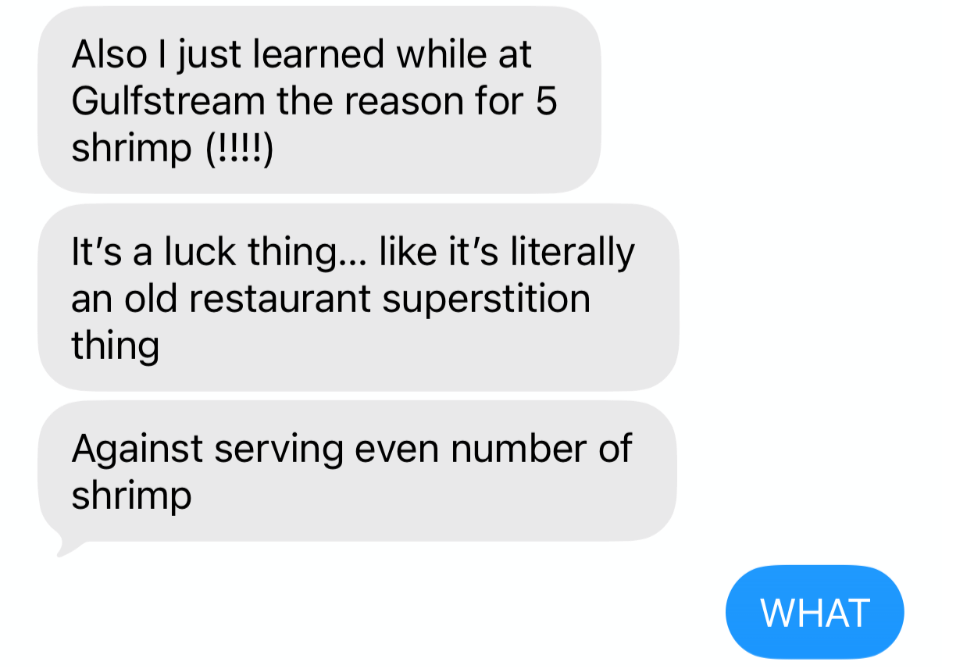
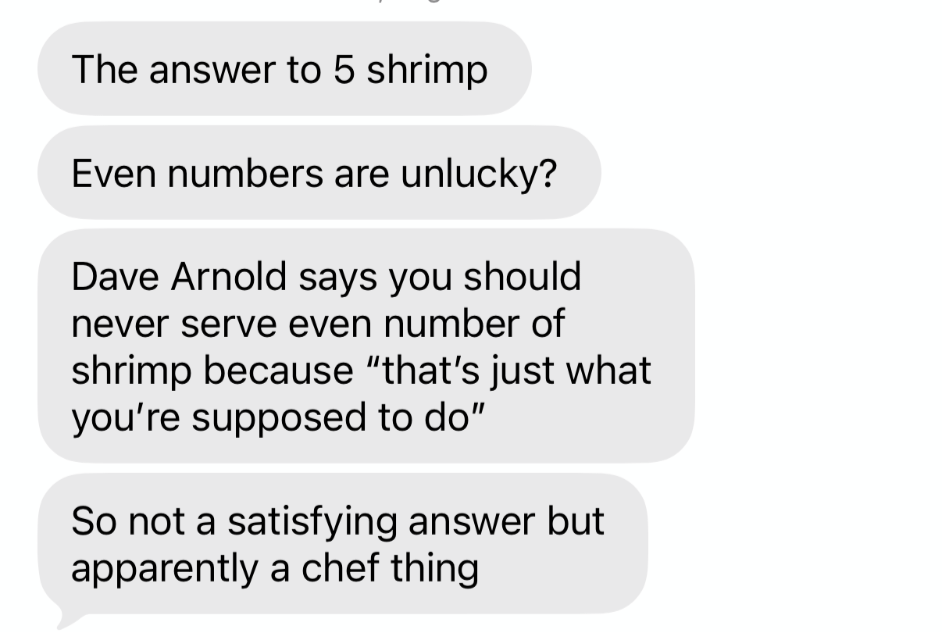
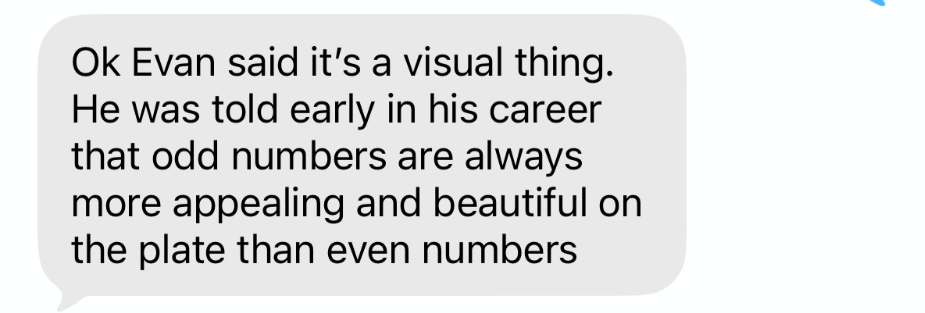
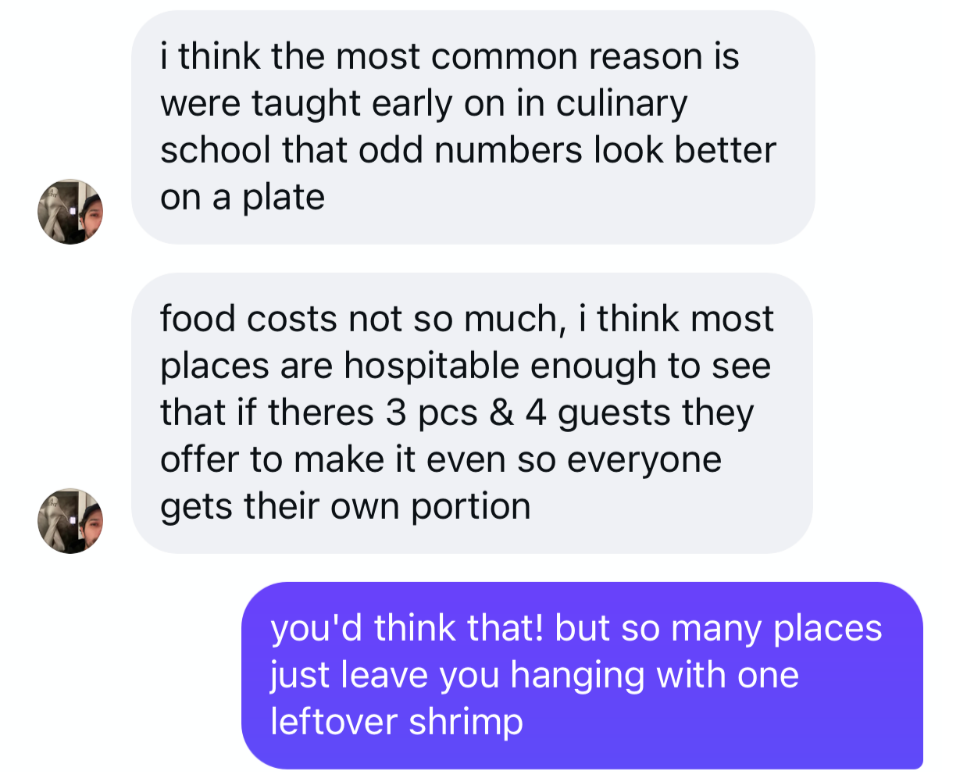
Still, I wasn’t satisfied. I called Ari Kolender, chef and partner at Found Oyster and Queen Raw Bar & Grill (who, it should be noted, has forged extensive relationships with domestic shrimpers to be able to consistently source wild, American-caught shrimp). “Why five shrimp? Well, it’s the rule of odds: odd numbers of things always look better,” he began. “But it really comes down to price,” he continued. “We want to be able to provide as much shrimp on the plate as possible for your hard-earned dollars, and we also want to make that dish not insanely expensive. You see shrimp cocktails out there in the $30 and up range, and we have a hard time asking people to pay that.”
He continued his lesson in shrimp economics: “Shrimp fluctuates in price, and our purveyors fluctuate as well. We haven’t always used the shrimp from Texas that we’re using right now, and there was a point in time at Queen where we served four, because we wanted to keep the price under a certain dollar amount. In order to do that, we needed to either eat our shirt, which we just can’t afford to do, or offer less, and we did. And we didn’t really get any pushback,” he said. “The feedback from our guests is never about the size or the amount of shrimp on the plate—it’s always about the price.”
In, ahem, this economy, Kolender’s explainer makes sense. And I know the old adage “appeal is half the meal” — I agree that odd numbers are more attractive to the human eye! But this is hospitality, after all, and savvy operators are in the business of anticipating their guests’ needs.
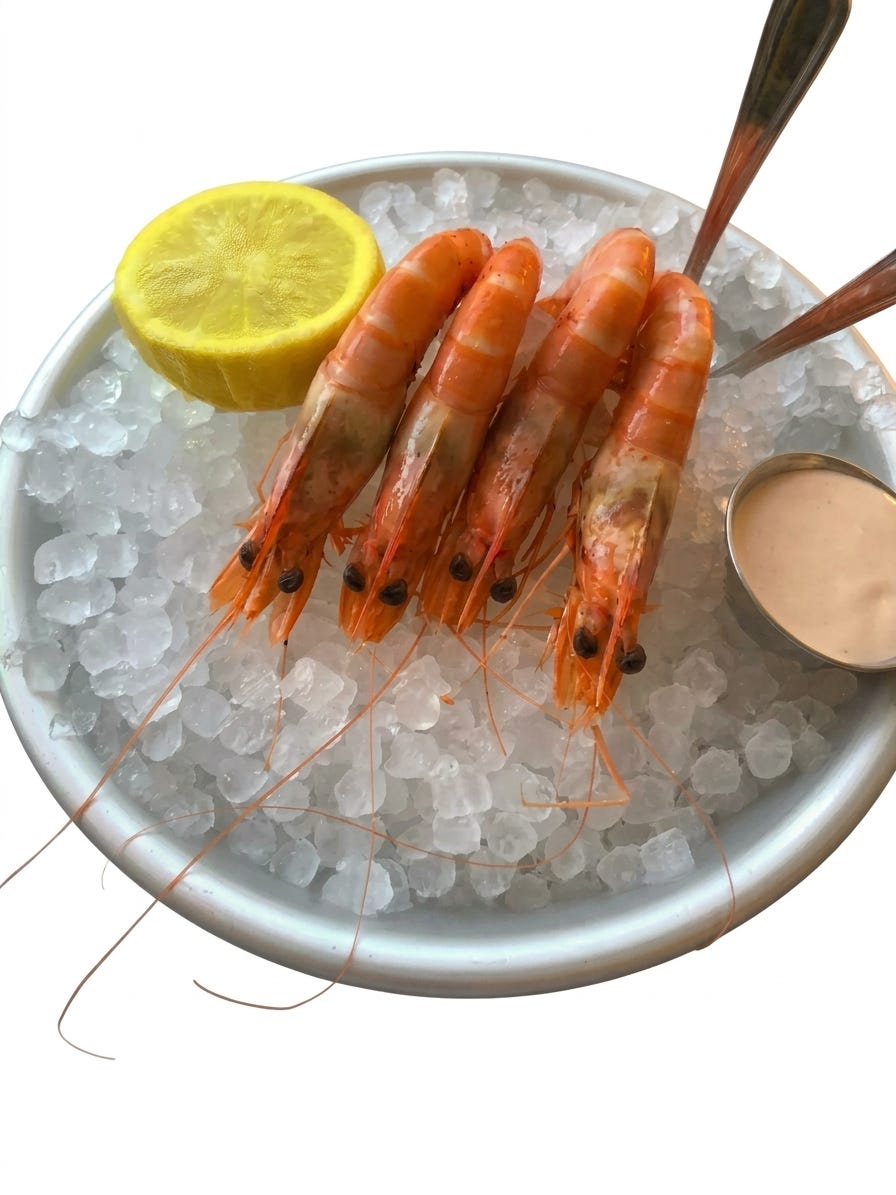
So here is my request, as a diner: if you serve an odd number of shrimp, and you see that I’m dining with an even number of people, give me the opportunity to add another shrimp. Charge me more, charge me anything! Maybe I’m in the minority here, but I will gladly pay extra to avoid the pain of trying to figure out what to do with the final shrimp.
Many already do, though not always proactively. “Sure, for money you get honey,” says Ron Schur, the owner of The Galley (who also recommended “a great psychiatrist” when I told him I’d been ruminating on why five shrimp for weeks). “We’re obviously always going to want to give people what they want, especially if it’s an addition,” says Kolender.
You’ll note that I’m not calling for restaurants to radically rethink their portioning, plating, or pricing. Operators have enough to deal with. I just want the option to tweak the number of shrimp, for a smooth share-plates experience for all. Who knows? I may not even exercise—I may have a particularly generous-in-the-shrimp-department dining companion, or I may be indulging in one of life’s greatest pleasures, dining solo. Five shrimp is five shrimp for a reason. Kolender, who grew up in the great shrimp town of Charleston, says when he thinks back to the shrimp cocktails he grew up with, they always came in magnitudes of five. “In my head,” he says, “I really can’t see it any other way.”